
Is your company prepared for the seismic shift in sustainable raw material sourcing? Traditional timber markets are volatile, and environmental regulations are tightening.
This creates a pressing need for a strategic alternative. One material is rising to meet this challenge, offering a rapid growth cycle and superior carbon capture.
The global market for products made from this grass is massive and growing fast. The bamboo pulp tissue sector alone is valued at $12 billion. It’s expanding much quicker than the overall tissue industry.
Mature manufacturing hubs, like China, prove this material’s potential for reliable, large-scale production. This report, from the experts at Smartcrop, provides a crucial framework for leaders.
We help you navigate procurement, mitigate risk, and build resilient partnerships. Smartcrop is a leading provider of commercial farming solutions and wholesale operations. Contact us at (954) 302-2529 or info@smartcropusa.com.
Key Takeaways
- Secure, cost-effective raw materials are critical with unstable timber markets.
- This fast-growing plant is a strategic replacement for traditional wood.
- The global market for related products is large and expanding rapidly.
- Asian supply chains now offer proven scale and manufacturing reliability.
- This report gives decision-makers a framework for successful procurement.
- Moving from niche to mainstream is driven by consumer and regulatory demand.
- Smartcrop provides expertise in farming, wholesale, and supply chain management.
Introduction to Long-Term Bamboo Supply Contracts
The move to sustainable sourcing isn’t just an environmental choice. It’s a core business strategy for future-proof operations. Leaders need a clear guide to navigate this new landscape.
Smartcrop’s Role in Sustainable Bamboo Farming
Smartcrop’s mission is to provide commercial farming services. This supports sustainable agriculture and reduces dependence on traditional timber. It also creates strong economic opportunities for U.S. businesses.
The company offers wholesale bamboo and tropical plants. These serve construction, manufacturing, and landscaping. Smartcrop ensures reliable supply chain management and quality.
Environmental stewardship is a key commitment. This fast-growing grass matures in just 3-5 years. It also produces 35% more oxygen than equivalent tree stands.
Overview of the Industry Report
This report equips procurement officers and sustainability leaders. It provides actionable insights for evaluating opportunities and building competitive chains.
The analysis uses a strategic framework. It examines the “Impossible Triangle” of balancing cost, compliance, and brand agility. The goal is to fill critical gaps in market information.
Based in Davie, FL, Smartcrop provides these sustainable solutions nationwide. For more information, contact (954) 302-2529 or info@smartcropusa.com.
The Growing Importance of Sustainable Bamboo Supply
A powerful convergence of consumer values and government policy is reshaping global material markets. Over 60% of shoppers worldwide say they will pay more for verified sustainable goods. This creates a strong brand equity investment for companies using resources like bamboo.
Environmental and Economic Benefits
Global “plastic bans” and initiatives like China’s push to replace plastic with bamboo are driving new demand. This regulatory shift opens up huge opportunities for alternative materials.
This grass matures in just 3-5 years, not decades. It captures more carbon per hectare each year than many forests. It also gives a higher biomass yield per acre, easing pressure on land.
For farmers, shorter harvest cycles mean multiple revenue streams within a decade. Lower input costs and climate resilience boost local economies. The total cost of ownership for end-products can be favorable due to strength and future carbon tariffs.
Natural properties like antimicrobial “bamboo kun” and superior absorbency allow for premium product claims. The world sees this resource’s dual potential to solve environmental issues while fueling commercial growth.
Bamboo as a Strategic Replacement for Timber Forest Productions
A detailed comparison reveals why this fast-growing grass is outmatching traditional timber in several key performance metrics. It provides a strategic alternative that reduces environmental impact without sacrificing quality.
Comparative Analysis with Traditional Wood Sources
The fibers from this grass average 2-3mm in length. Wood pulp fibers are typically only 1-1.5mm. This natural difference creates products with higher wet strength, superior softness, and less tearing.
An inherent antimicrobial agent, known as “bamboo kun,” is present in the material. This offers credible hygiene benefits not found in conventional wood pulp. It supports safer applications in tissue, food service, and healthcare products.
This resource also demonstrates far better absorption for both water and oil. This makes it ideal for high-performance tissue and cleaning materials where wood-based options fall short.
Classified as a grass, it can be harvested without killing the plant. The same root system regenerates continuously. This sustainable source can yield 10-15 times more raw material per acre than timber forests.
The processing flexibility is another major advantage. It can be fully bleached to a pure white or left in its natural hue. This supports diverse brand aesthetics, from “pure white” to “authentic eco.”
Its versatility is proven across construction, furniture, paper, and textiles. Companies like Smartcrop provide this high-performance material as a direct, reliable replacement for traditional wood sources.
Commercial Bamboo Farming Techniques and Innovations
Innovations in farming techniques are unlocking the full potential of this versatile plant. Smartcrop employs advanced commercial methods to maximize yield, quality, and sustainability.
Efficient Cultivation Strategies
With over 1,400 species globally, selecting the right one is crucial. Commercially proven varieties like Bambusa balcooa and Dendrocalamus strictus offer optimal growth rates.
Successful cultivation starts with proper site selection. This grass thrives in warm, tropical areas with ample rainfall. Soil preparation is key, requiring slightly acidic, well-drained land.
For large-scale operations, rhizome propagation is the most reliable method. Strategic spacing allows about 200 plants per acre, setting the stage for high-volume production.
Innovative Farming Practices
Growers use intercropping with ginger or turmeric during the first three years. This maximizes land use and provides additional revenue before the main harvest.
Organic mulching retains soil moisture and suppresses weeds. Selective culm removal within a clump promotes healthier new shoot development.
A consistent five-year timeline leads to the first commercial harvest. One acre can yield approximately 13.5 tonnes of raw material, creating substantial volumes for reliable sourcing.
Wholesale Bamboo and Tropical Plants: Diversifying Offerings
Beyond its role as a simple building material, this versatile grass enables a vast array of commercial products. For wholesale operations, this diversity is a core strength. It allows suppliers to serve multiple industries and build a resilient business model.
Expanding Product Portfolios
The applications are remarkably broad. In construction and furniture, it provides a strong, lightweight alternative to wood. Its fibers create soft, breathable textiles for clothing and home goods.
This resource is also a top choice for eco-friendly paper and packaging. The culinary world values its edible shoots for their unique flavor and nutrition. Landscapers use various tropical plants for decorative screens and privacy borders.
Additional markets include renewable energy from biomass and niche medicinal extracts. This wide range means wholesale suppliers can maximize yield from every part of the plant. Diversification spreads risk and taps into growing consumer demand across sectors.
Smartcrop’s wholesale division offers this diverse portfolio to meet client needs in construction, manufacturing, and landscaping. For inquiries, contact www.Smartcropusa.com or call (954) 302-2529.
Long Term Bamboo Supply Contracts
A well-designed procurement portfolio balances core reliability with agile flexibility. Multi-year agreements create the stability both growers and manufacturers need.
These deals are strategic, not just transactional. The five-year growth cycle of this grass requires forward planning. Short-term buying cannot provide the certainty needed for major investment.
The most resilient approach uses a primary “keystone” partner for 60-70% of core volume. Two or three “agile” partners add flexibility and innovation capacity. This structure mitigates risk across the entire chain.
Contract duration typically spans 3 to 10 years. This aligns with plantation timelines and processing infrastructure payback. Volume commitments include scaling provisions as harvests mature.
Clear quality specs define species, culm size, and moisture content. Pre-shipment inspections ensure consistent standards. Transparent pricing models foster trust.
Index-linked or cost-plus mechanisms tie costs to raw material markets. This avoids adversarial haggling. Security clauses guarantee capacity allocation and define remedies for non-performance.
Smartcrop specializes in structuring these partnerships. We ensure consistent quality, reliable delivery, and mutual benefit for a stable future.
Market Trends and Data Analysis in the Bamboo Industry
Quantifiable data reveals the accelerating momentum behind eco-friendly material markets worldwide. This analysis provides critical information for strategic planning.
Global Demand and Market Dynamics
Regulatory pressures and consumer preferences are key demand drivers. Over 60% of global shoppers pay premiums for verified sustainable goods.
China dominates production with over 2.35 million tons annually. Japan leads per-person use, consuming about 200 pairs of chopsticks per year. Emerging markets in Southeast Asia and North America show fast growth.
Data-Driven Insights and Tables
Price trends show significant movement. Chinese export unit costs rose 11.16% in one recent period.
The table below compares key product segments and their market dynamics.
| Product Category | Market Size / Volume | Price Range | Primary Region |
|---|---|---|---|
| Bamboo Pulp Tissue | $12 Billion (2024) | N/A | Global |
| Disposable Chopsticks | 60-80 Billion sets | $900-$1,100/ton | China, Japan |
| Incense Sticks | Varies by length | $750-$800/ton | Vietnam |
| Barbecue Skewers | Retail volume | $1.50-$1.67/kg | Southeast Asia |
Trade flows highlight China’s dual role. It exports 60% of its chopstick production, mainly to Japan and South Korea. Domestic demand absorbs the rest.
The North American market forecast is strong. It is driven by sustainability initiatives and foodservice adoption.
Risk Management Strategies for Bamboo Supply Chains

True supply security involves guarding against compliance failures and delivery uncertainties, not just cost swings. Critical breakdowns in procurement often stem from unverified eco-claims, inconsistent quality, and logistical delays.
Addressing Price Volatility and Quality Issues
Smart management of cost fluctuations is essential. Index-linked pricing ties your rate to a transparent commodity index. This creates a fair and predictable price structure for both buyer and supplier.
Written quality specifications are your first defense. Define tolerances for moisture content, fiber length, and strength. Pre-shipment samples and third-party inspection rights enforce these standards.
Diversifying your supplier base is a key risk mitigation factor. Avoid over-reliance on a single source. A portfolio approach with primary and secondary partners ensures continuity.
This holistic view protects your raw material flow and brand reputation. It turns potential vulnerabilities into a competitive advantage for resilient sourcing.
Strategic Procurement: Balancing Cost, Compliance, and Growth
Choosing the right sourcing pathway defines a company’s competitive edge and market position. Leaders must navigate the “Impossible Triangle” of procurement. This framework highlights the trade-off between minimizing unit cost, meeting strict compliance standards, and enabling rapid brand growth.
Frameworks for Supplier Selection
Four primary strategy pathways exist for a buyer. The Cost Efficiency approach prioritizes low unit costs with baseline compliance. It suits large B2B deals and hospitality groups.
Compliance & Safety focuses on unimpeachable credentials like EU Ecolabel. This path is vital for brands targeting European markets or seeking B-Corp status.
Agile Branding leverages North American ecosystems for fast product launches. It empowers startups and digital-native brands. Balanced Resilience uses a “China+1” supply web for global multinationals.
Selecting a partner requires evaluating technical capability, financial health, and operational excellence. Data-driven decisions rely on performance metrics and quality testing.
Strategic procurement moves beyond transactions. It builds partnerships where suppliers share risks and rewards. This integration is key for long-term business value and a stable bamboo supply.
Leveraging Smartcrop’s Expertise for Resilient Supply Chains
Expert guidance transforms raw material sourcing from a cost center into a strategic asset. Smartcrop acts as your supply chain integrator and de-risking agent. We translate your strategic goals into detailed procurement specifications and compliance roadmaps.
Building Flexible Partnerships
We build partnerships that balance firm volume commitments with market responsiveness. Our team manages the supplier portfolio on your behalf. We identify and qualify both primary “keystone” partners for core volume and secondary “agile” suppliers.
This structure accommodates seasonal demand swings and new product line expansions. It also supports geographic market entry strategies for your company’s growth.
Adapting to Market Demands
We continuously monitor industry trends, regulatory changes, and consumer preferences. This allows us to adapt your sourcing strategy to evolving market demands. Our support includes business model development for market entry and expansion.
We help assess capital requirements and forecast costs. Smartcrop guarantees every shipment has correct documentation and compliance assurance. This protects your brand from regulatory and reputational exposure.
As a U.S.-based specialist, we understand American market requirements. We maintain strong relationships with international growers. Contact Smartcrop at (954) 302-2529 or info@smartcropusa.com to build a resilient supply chain.
Insights into Contract Negotiation and Pricing Models
A transparent pricing framework is the cornerstone of any successful and enduring material partnership. Moving beyond simple haggling to a shared understanding of value builds stronger alliances.
Establishing Transparent Cost Structures
The goal is to create agreements where both parties win. This means understanding all cost drivers, from raw material to logistics. A clear structure prevents surprises and builds trust.
Several pricing models exist, each with distinct trade-offs. The table below compares the most common approaches for a buyer to consider.
| Pricing Model | Key Advantage | Primary Risk | Best For |
|---|---|---|---|
| Fixed-Price | Budget certainty | Market misalignment | Stable, predictable demand |
| Index-Linked | Market fairness | Index volatility | Long-term, high-volume deals |
| Cost-Plus | Full cost transparency | Verification overhead | Complex, custom specifications |
| Hybrid | Balanced flexibility | Increased complexity | Dynamic market conditions |
Smart negotiation focuses on the right questions. Ask about review clauses and written quality tolerances. Inquire about capacity allocation for your forecasted order volume.
This approach shifts the discussion from adversarial to collaborative. It secures a fair price and a reliable flow of this versatile grass.
Integrating Technology in Bamboo Farming and Processing
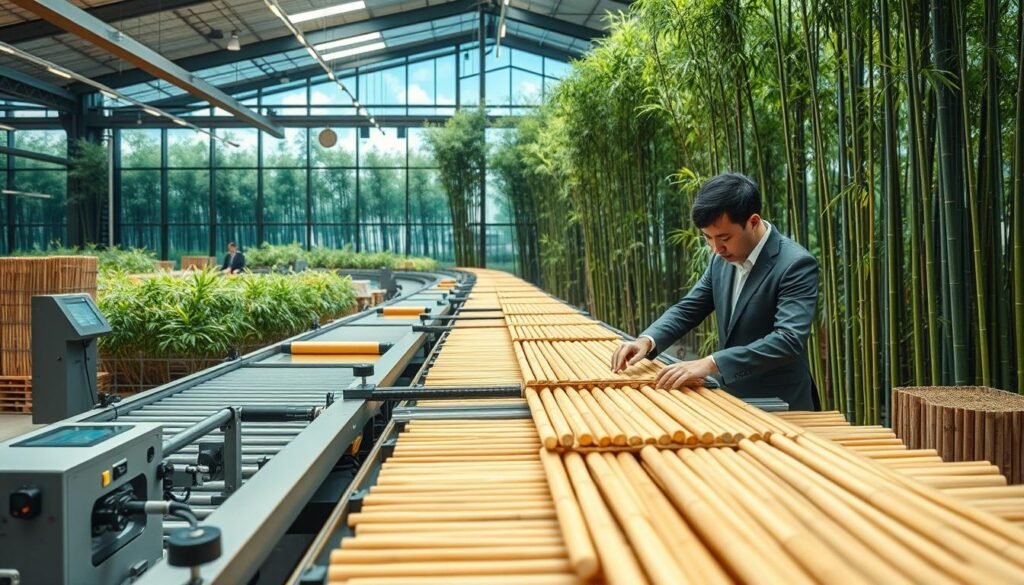
From field to factory, advanced systems are boosting the efficiency and quality of this sustainable resource. Technology integration starts at the plantation.
Precision agriculture tools optimize plant spacing and monitor soil moisture. Nutrient management platforms track growth rates to maximize yield per acre. This ensures superior raw material for manufacturing.
The processing evolution moves from manual methods to fully automated lines. This shift enables industrial-scale production with consistent quality. The core stages remain crucial.
Raw culms are cut, split, and dried under controlled conditions. Precise sizing and shaping follow. Automated sorting and strength testing ensure every piece meets specs.
| Feature | Low-Tech Approach | High-Tech Systems |
|---|---|---|
| Scale | Small-scale, artisanal | Industrial, multiple tons daily |
| Quality Consistency | Variable, skill-dependent | High, machine-controlled |
| Capital Requirement | Low | Significant investment |
| Best For | Local markets, limited capital | Export, large-volume contracts |
Modern drying ovens prevent warping. Automated polishers create a smooth finish. This technical control is vital for diverse products, from worldwide pulping and papermaking to construction.
Traceability platforms track material from harvest to shipment. This supports sustainability claims. Waste reduction tech converts off-cuts into usable biomass, closing the loop on a efficient production cycle.
Investment and Market Opportunity Analysis for Bamboo Products
Investors seeking durable growth are turning their attention to a resource with remarkable financial and ecological returns. A detailed analysis reveals strong potential across farming and processing ventures.
Capital Efficiency and Revenue Models
Initial capital outlay varies by scale. Farming requires funds for land, plants, and irrigation. Processing facilities range from manual setups to fully automated lines.
This grass matures in about five years. One acre can yield 13.5 tonnes at first harvest. After that, annual harvests create a steady revenue stream for decades.
Wholesale pricing differs by product category. Chopsticks fetch $900-$1,100 per ton. Barbecue sticks command $1.50-$1.67 per kilogram.
Profitability indicators are attractive. Integrated operations often see payback in 5-8 years. Return on investment can range from 15% to 30%.
Smart strategies boost capital efficiency. A phased approach starts with farming. Contract growing or toll processing can reduce upfront costs.
The market opportunity is large and growing. Key segments include sustainable consumer products and construction materials. North America presents a favorable growth trajectory for new production.
Ensuring Compliance with Regulatory and Sustainability Standards
For businesses aiming to lead in sustainable markets, adherence to recognized certifications separates leaders from followers. Any “green” product must first meet high performance expectations for strength and softness.
FSC and EU Ecolabel Certifications
FSC (Forest Stewardship Council) certification is the non-negotiable baseline for credible claims. It requires chain-of-custody documentation and regular audits.
This status enables access to developed markets with strict sustainability requirements. EU Ecolabel certification serves as a master key for premium markets.
It demonstrates comprehensive environmental performance across the entire product lifecycle.
Mitigating Regulatory Risks
Emerging carbon rules, like the EU’s CBAM, will translate embedded carbon into cost. The rapid growth of this grass offers a clear sequestration advantage.
Food safety and health certifications are critical for products like chopsticks and tissue. FDA and EU food contact regulations mandate specific testing for chemical migration.
Phytosanitary requirements govern material movement across borders. Heat treatment and pest inspection protocols vary by importing country.
| Standard | Primary Focus | Key Verification |
|---|---|---|
| FSC Certification | Sustainable Forest Management | Chain-of-Custody Audit |
| EU Ecolabel | Full Lifecycle Impact | Comprehensive Criteria Audit |
| EU CBAM | Embedded Carbon Cost | Emissions Data Reporting |
| FDA Food Contact | Consumer Safety | Migration Testing |
Risk mitigation includes supplier audit rights and pre-shipment lab testing. Unsubstantiated claims create major reputational risks.
Robust data management systems are essential. They maintain traceability records from plantation to final product for audits.
This documentation supports compliance in global trade and protects your brand.
Tailoring Bamboo Supply Solutions for U.S. Markets
The United States presents a unique opportunity for sustainable material suppliers. Premium pricing meets sophisticated demand for product transparency here.
Over 60% of American shoppers will pay 5-15% more for verified eco-friendly goods. This creates a strong market for products with clear sustainability stories.
Success requires deep regional customization. Packaging needs English labels and recyclability claims. Product specs must match American expectations for finish and quality.
Regional Customization and Scalability
Coastal urban areas like California show high eco-consciousness. Other regions may prioritize value. Your strategy must adapt to these local preferences.
Scaling from a pilot test to national distribution is a key challenge. It involves complex logistics and inventory management. Smartcrop, based in Davie, FL, understands these U.S. markets intimately.
We help clients navigate federal and state rules. Our location offers proximity to major East Coast hubs. This allows for responsive service and reliable supply.
Entry strategies include partnerships with distributors and digital marketing. The potential in foodservice and retail segments is substantial. Contact Smartcrop at (954) 302-2529 or info@smartcropusa.com for tailored solutions.
Final Reflections on Securing a Sustainable Bamboo Future
The era of spot buying for critical materials is ending. It is replaced by collaborative frameworks built for decades.
This fast-growing grass requires a five-year cycle. Its substantial benefits and strong market growth create a compelling case. Success demands a shift from transactional thinking to a strategic partnership model.
The most resilient strategy uses a portfolio approach. Balance primary partners for volume with agile suppliers for flexibility. Align your sourcing with core priorities across cost, compliance, and growth.
Early movers gain a lasting competitive edge. They secure preferred relationships and build vital knowledge. Start your journey with a clear internal workshop.
Smartcrop is committed to supporting your business. We provide expert guidance for reliable partnerships. Contact us at (954) 302-2529, email info@smartcropusa.com, or visit www.Smartcropusa.com. Let’s build a sustainable future together.