What if the ‘eco-friendly’ bamboo product you just bought is actually harming the planet?
This fast-growing grass is celebrated as a green material. Yet, its booming demand has a dark side. Similar to the palm oil industry, rapid growth can lead to habitat destruction and poor practices.
Over 85% of global bamboo textiles are chemically processed viscose. In 2023, the EU flagged hundreds of textile shipments for safety issues. Many were labeled as “eco-bamboo” without proof.
This is where credible certifications become essential. They are the verifiable proof that separates truly responsible products from greenwashed claims.
As a leader in commercial cultivation, Smartcrop is your guide. We help conscientious buyers navigate this complex landscape.
This guide will empower you. You’ll learn about key labels like FSC and GOTS. These ensure environmental, social, and safety standards are met.
Key Takeaways
- High demand for bamboo can lead to unsustainable practices, similar to other commodity crops.
- Many “green” bamboo items on the market lack third-party verification of their claims.
- Regulatory bodies are increasingly cracking down on falsely labeled products.
- Trustworthy certifications provide crucial proof of environmental and social responsibility.
- This guide is designed for procurement managers, retailers, and conscious consumers.
- Understanding different certification types is key to making informed purchasing decisions.
Understanding the Scope of Sustainable Bamboo Farming
Manufacturers are increasingly turning to a remarkable grass to meet the demand for greener products. This shift is transforming the global materials landscape.
The Rise of Bamboo in Eco-Friendly Industries
This versatile plant is now a cornerstone in textiles, paper, furniture, and construction. Its explosive growth—up to three feet daily—makes it highly renewable.
Compared to traditional timber or cotton, it needs far less water and virtually no pesticides. This efficiency drives its adoption across the world.
How Bamboo Supports Sustainable Timber Alternatives
As a superior forest product substitute, it helps protect old-growth forests. Its rapid renewability eases pressure on these vital ecosystems.
Companies like Smartcrop lead in commercial cultivation. They supply wholesale materials that directly replace timber in flooring, cabinetry, and more.
This grass also sequesters carbon and prevents soil erosion. Responsible cultivation supports biodiversity and watershed health.
The industry’s rapid expansion brings great potential. Yet, it requires careful management to ensure long-term ecological benefits.
Defining Sustainable Bamboo Farming Certifications
Third-party verification systems transform vague promises into concrete, measurable actions. These labels are not just logos. They are rigorous proof of adherence to strict standards.
What It Means for the Environment and Consumers
For the planet, a valid certification ensures stewardship. It protects natural habitats and promotes soil health. Responsible practices also safeguard water resources and biodiversity.
For consumers, it provides vital assurance. You know a product is safe and ethically made. Your purchase supports positive outcomes instead of harmful operations.
Organizations like the World Wildlife Fund outline key assessment areas:
- Protection of sensitive ecosystems from conversion.
- Management of harvest rates to prevent depletion.
- Restriction of harmful chemical inputs.
- Positive social impact on local communities.
These certifications have become essential. They are the primary tool for fighting false claims. They build trust by offering verifiable proof of sustainability from source to shelf.
Sustainable Bamboo Farming Certifications – The Key to Ethical Sourcing
The 2010 FTC crackdown on false ‘bamboo fabric’ labels taught retailers a hard lesson. Without verified proof, ethical sourcing is just a guess. Third-party labels are the cornerstone of responsible procurement.
They create accountability across complex global supply chain networks. Buyers can trace materials from origin to final product. This ensures no harmful practices occur at any stage.
These systems provide documented transparency. They show sourcing locations, methods, and labor conditions. This proof helps companies comply with laws like the U.S. Lacey Act.
| Aspect | Certified Sourcing | Uncertified Sourcing |
|---|---|---|
| Origin Verification | Full traceability from forest to factory | Unknown or obscured origins |
| Environmental Practices | Audited for soil health and biodiversity | Risk of habitat destruction |
| Social & Labor Conditions | Fair wages and safe work standards | Potential worker exploitation |
| Regulatory Compliance | Meets EUTR, UKTR, and Lacey Act | High risk of legal penalties |
| Business Risk | Low; protects brand reputation | High; exposes to recalls and fines |
Choosing certified bamboo is a business necessity. It mitigates risk and builds consumer trust. Smartcrop’s commitment to these labels ensures your wholesale operations support only verified, responsible cultivation.
Exploring FSC Certification for Bamboo Products
Independent verification by the Forest Stewardship Council separates credible products from mere marketing. This nonprofit sets the global benchmark for responsible land use. Its mission is to end deforestation.
The Council covers this fast-growing grass as a non-timber forest product. This gives buyers a clear way to identify ethical sources.
FSC Forest Management vs. Chain of Custody
Two linked certificates create a full proof system. Forest Management (FM) applies to the growing land. It verifies harvest rates protect biodiversity and help local communities.
Chain of Custody (CoC) tracks the material after harvest. Every manufacturer and trader in the supply chain must hold it. If one link is missing, the final item cannot be called FSC certified.
How FSC Ensures Traceability and Transparency
The system uses third-party audits and strict paperwork. Each transaction is recorded. Buyers can check any supplier’s claims in a public online database.
You simply enter a certificate number to verify its status. This control prevents fraud and ensures transparency from forest to shelf.
| FSC Label Type | Material Source | Key Benefit |
|---|---|---|
| FSC 100% | Entirely from certified forests | Highest standard, full traceability |
| FSC Recycled | 100% recycled content | Reduces waste, supports circular economy |
| FSC Mix | Mix of certified, recycled, & controlled wood | Flexible while maintaining oversight |
Adoption of these standards is growing but not universal. For example, only 33% of top brands in certain product categories are FSC certified. Responsible companies, like Save Trees (certificate C041262), use it to prove their material comes from known regions like Chishui City.
Evaluating Other Critical Certifications for Bamboo
Beyond forest management standards, buyers must evaluate processing certifications that guarantee product safety and organic integrity. These labels verify what happens after harvest, ensuring final goods meet strict international benchmarks.
OEKO-TEX® and Its Role in Chemical Safety
The OEKO-TEX® Standard 100 is the global benchmark for textile safety. It tests finished fabrics for over 350 harmful substances, including formaldehyde and heavy metals.
This certification uses a tiered class system:
- Class I: For baby products requiring the strictest standards.
- Class II: For items in direct skin contact, like apparel.
- Class III: For non-contact home textiles.
GOTS and Additional International Standards
The Global Organic Textile Standard (GOTS) is the strictest framework for organic textiles. It requires a minimum of 70% organic fiber content for label eligibility.
GOTS certification prohibits toxic inputs and mandates social compliance. It provides complete traceability from organic fiber to finished fabric.
A key distinction exists between mechanically processed bamboo, which can qualify as organic, and chemically processed viscose. Understanding this difference prevents misleading claims.
Regulatory standards like EU REACH and U.S. CPSIA are mandatory for market access. They differ from voluntary certifications but remain essential.
These various labels work together. FSC addresses sourcing, OEKO-TEX® ensures chemical safety, and GOTS verifies organic processing. A 2024 report found 68% of European buyers prefer items with these tags, even at higher prices.
The Environmental and Economic Benefits of Certified Bamboo
Choosing verified materials delivers a powerful dual advantage: protecting ecosystems while boosting business performance.
This grass absorbs more carbon than most trees. It also stabilizes soil and needs little water. Third-party labels ensure these natural benefits are realized, preventing harmful practices.
The economic impact is equally clear. Brands like Kleinkind Natur saw a 22% sales jump after adopting verified sourcing. Customers trust proven labels, paying a premium for them.
Supply chains become more efficient. Compliance is simpler, and risk drops. This creates a strong brand reputation in a crowded market.
Long-term, this approach builds business resilience. It aligns with future regulations and reporting needs. Verified production turns ecological responsibility into a competitive edge.
Identifying and Verifying Certification Labels
Before you commit to a purchase, a simple verification step can protect your business from risk. Genuine third-party verification separates proven responsibility from empty marketing claims.
Smart buyers always check the proof behind a label. This process ensures the bamboo products you source meet the standards you promise to your customers.
Tips for Recognizing Authentic Certification Marks
First, always request the exact certificate number from your supplier. Every legitimate certification has a unique ID issued by an accredited body like Control Union or SGS.
Next, verify this number in the official online database. For FSC certification for bamboo products, use the FSC database search tool. Check the OEKO-TEX® Certificate Check and GOTS Public Database for other labels.
Confirm the scope listed includes the specific items you are ordering. Also, check the validity date; most certificates renew annually.
Major red flags include a supplier’s reluctance to share their label number or a scope that doesn’t match your order. An expired certification is invalid.
Incorporate this verification into your procurement contracts. Require current certificates and periodic re-checks. This practice shields your brand and ensures true FSC chain of custody.
Common Myths and Pitfalls in Certification Claims
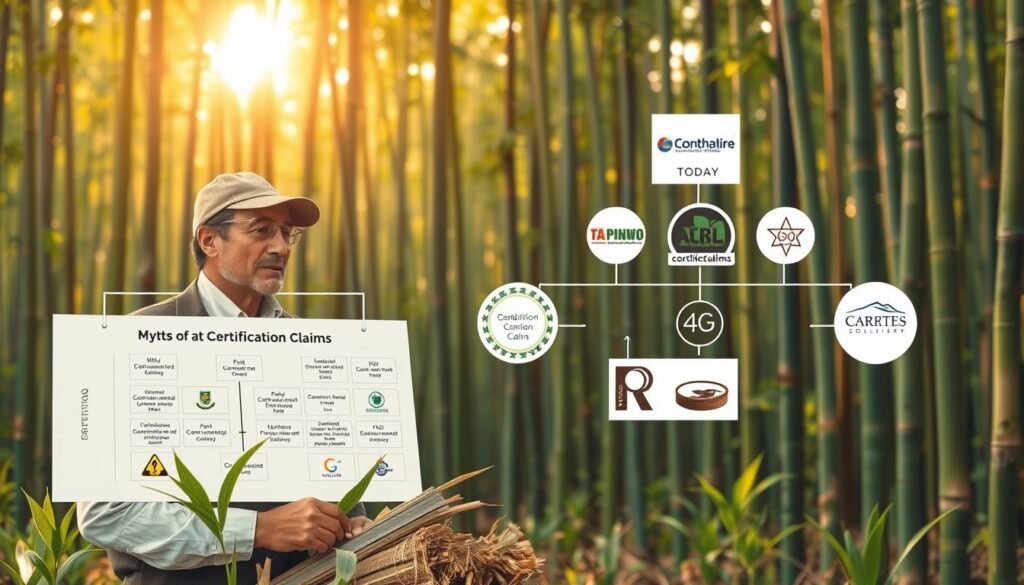
The path to truly responsible sourcing is littered with common, expensive misconceptions about verification. These misunderstandings can expose your business to significant risk.
A major misunderstanding is thinking certified raw material makes the final product certified. For systems like FSC, every handler needs a Chain of Custody certification. Without it, the label claim is invalid.
Another trap is the “organic bamboo” claim for viscose. This chemically processed fiber cannot be organic. True organic claims apply only to mechanically processed fibers or certified lyocell.
Be wary of self-created eco-labels. Only independent, audited certifications offer real assurance. Always verify a certificate number in the official database.
Failing to check has hurt major brands. In 2023, a European retailer recalled baby clothing with unverified viscose. The U.S. FTC also fines companies for false “bamboo fabric” claims.
Smartcrop addresses these issues openly. We ensure every step in our supply chain holds valid certifications. This protects your brands and the integrity of your products.
Leveraging Technology for Supply Chain Transparency
Blockchain, QR codes, and AI are transforming how we verify the origins and integrity of responsible products. Modern tools create an unbreakable digital thread from forest to finished item.
This shift moves proof beyond paper. It enables real-time transparency and robust control.
Digital Tracking and Verification Tools
Certification bodies now use advanced technology. Satellite imagery monitors forest areas. AI cross-checks purchase volumes against harvest data to prevent fraud.
Factories must have a strict internal control system. This includes physically separating certified batches. Digital inventory logs track every movement.
Buyers have powerful verification tools at their fingertips. Online databases check certificate numbers in seconds. Mobile apps scan QR codes on product labels for instant source details.
| Technology | Primary Function | Key Benefit |
|---|---|---|
| Blockchain | Creates immutable record of each transaction | Eliminates data tampering; ensures full chain of custody |
| QR Codes | Links physical products to digital documentation | Provides consumers and buyers instant origin story |
| Centralized Databases | Stores all audit and certificate data in one cloud platform | Enables real-time checks and simplifies due diligence |
This tech-driven approach minimizes business risk. It provides auditable data for sustainability reports. True traceability builds unshakable consumer trust.
Best Practices for Sourcing Certified Bamboo with Smartcrop
Partnering with the right supplier is the most critical step in securing truly responsible materials. China is a major producer, but compliance with standards like FSC varies widely. Not all factories hold valid credentials, and some misuse claims.
This makes choosing an experienced, verified manufacturer essential. Your company‘s reputation and product line depend on it.
Our Commitment to Certifications and Sustainable Practices
Smartcrop operates with full commitment to verified practices. We maintain active labels and undergo regular third-party audits. Our transparent documentation provides full traceability from our Florida cultivation sites.
Our commercial farming operations in Davie prioritize environmental stewardship. We supply wholesale plants and materials that serve as direct timber replacements.
We help clients transition to more sustainable sourcing. Our guidance ensures your manufacturing process supports only verified, responsible supply chains.
Contacting Smartcrop for Expert Guidance
Our team offers expert guidance on complex certifications. We assist with compliance documentation and educate on market expectations.
We recommend establishing clear requirements in your purchase specifications. Always verify supplier credentials before commitment and conduct periodic audits.
Connect with us for your certified bamboo needs. Visit www.Smartcropusa.com for details. Call (954) 302-2529 to speak with a specialist.
Email info@smartcropusa.com for quotes. Or visit our facility at 2100 SW 154th Ave, Davie, FL 33326. See our operations and discuss your specific sourcing requirements.
Final Thoughts on Sustainable Bamboo Farming Certification Standards
In an era of environmental accountability, proof has become the new currency. For global brands, verified sourcing is both an ethical duty and a commercial necessity. It protects your reputation and ensures regulatory compliance.
Third-party labels like FSC and OEKO-TEX® provide this vital proof. They are the auditable standards that separate real responsibility from marketing claims. This verification ensures safe products for consumers.
This approach builds undeniable trust in the market. It reduces business risk and creates a powerful competitive edge. Your investment supports a positive impact.
Partner with Smartcrop to navigate this essential way forward. Our commitment to verified sourcing delivers the credibility your brand requires. Contact us to build a more responsible product line.