What if the future of construction isn’t built with steel or concrete, but with a grass that grows faster than trees?
This isn’t science fiction. It’s the reality being shaped by one of the world’s most versatile plants. As a rapidly renewable material, it is revolutionizing how we build and manufacture.
While over 1,600 distinct types of this plant exist globally, only a small fraction—about 90—have the documented strength for serious building work. This highlights a crucial point: not all varieties are created equal.
Technically a giant grass, it offers exceptional durability and can regenerate quickly. These traits make it a superior alternative to traditional timber in many scenarios.
The champions of this movement come from three primary genera. Guadua is known in South America. Dendrocalamus thrives in Southeast Asia. Bambusa is widespread across tropical zones.
Tropical varieties generally outperform their temperate cousins. They have larger dimensions, thicker walls, and better structural properties.
This article explores the specific plants leading this change. We’ll also look at how sustainable cultivation, pioneered by firms like Smartcrop, is creating reliable wholesale supplies for industries seeking timber alternatives.
Key Takeaways
- Only a select group of about 90 types out of thousands are suitable for major construction and manufacturing projects.
- The material is technically a fast-growing grass, offering durability and rapid regeneration that outpaces traditional wood.
- Three main genera—Guadua, Dendrocalamus, and Bambusa—provide the most valuable resources for global industries.
- Tropical varieties are typically stronger and larger than those grown in temperate climates.
- Sustainable commercial farming is essential to meet growing demand and provide a consistent supply chain.
- This resource is positioning itself as a viable and eco-friendly replacement for conventional timber forest products.
- Understanding the right type for the job is key to unlocking its full potential in building and design.
Introduction to Bamboo as an Industrial Material
Its classification as a grass, not a tree, is the first clue to its revolutionary potential as a modern resource. This botanical distinction means it can be harvested without killing the plant. The root system stays alive and quickly sends up new shoots.
The plant’s cellular structure creates an exceptional strength-to-weight ratio. Microscopic fibers run longitudinally, providing tensile strength comparable to steel. Yet it remains remarkably lightweight for easy handling and transport.
Unique growth characteristics further enhance its value. Hollow culms make efficient use of material. A network of underground rhizomes allows rapid regeneration after cutting. Sturdy nodes along each stalk provide natural reinforcement points.
Communities have utilized these natural traits for millennia in tools and shelters. Today, improved processing unlocks its full potential for commercial applications. Proper treatment and quality control transform it into a reliable, high-performance resource.
The Rise of Bamboo as a Sustainable Timber Replacement
The world faces a silent crisis as forests vanish, but a perennial grass offers a powerful solution. Deforestation drives an urgent need for sustainable alternatives to traditional wood.
This remarkable plant matures in just 3 to 5 years. In stark contrast, timber trees often need 10 to 30 years to grow. This rapid growth cycle meets industrial demand without long-term depletion.
Harvesting is an annual event after initial maturity. Workers cut only the mature culms, leaving the root system and young shoots untouched. The rhizome network continuously generates new growth, creating a perpetual resource.
Replacing just 10% of conventional plywood with these alternatives could significantly ease pressure on endangered forests. The yield per acre is much higher than tree forests.
Commercial farms, like Smartcrop, are vital. They provide reliable, wholesale supplies so industries can transition away from timber dependency. This fast-growing resource is both economically viable for farmers and commercially attractive for buyers seeking better materials.
Advantages of Using Bamboo for Construction
Modern architects are turning to a natural resource that outperforms wood in almost every mechanical test.
This grass offers a unique blend of lightness and toughness. Its tensile strength reaches about 160 N/mm². That figure is triple the power of most standard woods.
| Mechanical Property | Bamboo | Conventional Timber |
|---|---|---|
| Tensile Strength | ~160 N/mm² | ~53 N/mm² |
| Compressive Strength | 40-80 N/mm² | 20-40 N/mm² |
| Bending Strength | 50-150 N/mm² | 25-75 N/mm² |
Compressive strength ranges from 40 to 80 N/mm². This makes it perfect for load-bearing walls and posts.
Bending strength is equally impressive. It allows for creative, curved architectural designs.
The material is naturally flexible and resists splitting. Its segmented culms have nodes that act as built-in reinforcement.
This combination supports many applications. It works for everything from temporary scaffolding to permanent structures.
Its light weight cuts transport costs. The natural flexibility provides excellent earthquake resistance in seismic zones.
Remember, these properties can change. They depend on the plant’s age, moisture, and the specific part used.
Bamboo Species Industrial Use
Only a handful of grasses from tropical climates meet the strict standards for load-bearing applications. With over 1,600 distinct types globally, a mere 90 have proven construction-grade properties.
Selecting the right plant is crucially important for any project. Tropical varieties dominate the industry because they grow taller with thicker walls.
This gives them far superior structural and mechanical traits compared to temperate types. Three primary genera provide the most valuable resources.
Guadua offers immense strength and is primarily South American. Dendrocalamus includes large Asian giants. Bambusa contains versatile and widespread types.
Each group has unique advantages. Some yield large, straight culms perfect for beams. Others provide remarkable flexibility for curved designs or visual appeal.
Matching these characteristics to the specific job is key. Expert suppliers can guide this selection based on local growing conditions and intended use.
Key Characteristics of High-Performance Bamboo Species
Not all tall grasses are equal; their internal architecture determines their load-bearing capacity. For construction, wall thickness is the single most critical characteristic. Thick-walled varieties can support heavy loads in permanent structures like multi-story buildings.
High-performance bamboo species typically have culm diameters of 10 to 20 centimeters or more. They often reach heights of 20 to 30 meters. This provides substantial material for major projects.
These characteristics change along the culm’s length. The basal part can be solid or extremely thick-walled. The mid-section offers an optimal balance for strength. The upper portion is thinner and lighter.
Straight culms with minimal tapering are vital. Consistent dimensions simplify joinery and load calculations. Fiber density within the walls also dictates tensile and compressive strength.
Longer internodes provide more usable building material but may affect overall rigidity. Growth conditions like soil, climate, and altitude influence these traits. Plants from slopes often develop superior strength compared to those from valleys.
Visual identification helps ensure proper selection. Look at node appearance, culm color, and branching patterns. Matching these physical characteristics to the project’s needs is essential for success.
Factors Influencing Bamboo Growth and Quality
The final strength of a bamboo culm is not just genetics. It’s shaped by the environment it grows in. Several key factors determine the final quality of this remarkable material.
Environmental Conditions and Soil Quality
Climate is a major driver. Temperature, rainfall, and humidity directly impact growth rates and fiber development. Plants on sunny slopes often develop superior strength compared to those in shaded valleys.
Surprisingly, soil quality works in reverse. Nutrient-poor or dry soil forces the plant to develop denser, stronger fibers. Rich, moist soil leads to faster but less robust growth.
Age and Harvesting Practices
Timing is everything. The optimal age for harvesting is typically 3 to 6 years. At this stage, compressive strength peaks while tensile strength remains high.
Cutting too early results in weak culms. Waiting too long increases brittleness. After cutting, moisture content must be carefully reduced from over 50% to a stable 10-15%.
Different parts of the culm offer varied properties. The thick basal section is best for heavy loads. The middle offers a good balance. The top is suited for lighter, non-structural uses.
Proper spacing and selective cutting are essential factors for consistent, high-grade output from any species.
Notable Global Bamboo Varieties in Construction
Five distinct varieties have emerged as the backbone of modern building projects worldwide. These plants are Dendrocalamus asper, Gigantochloa apus, Bambusa blumeana, Guadua angustifolia, and Phyllostachys edulis. They represent the most reliable and widely available construction-grade grasses across different regions.
Geography plays a huge role. Guadua angustifolia dominates South American construction. Dendrocalamus and Gigantochloa types are prevalent across Southeast Asia. Bambusa varieties are widespread in tropical Asia, while Phyllostachys edulis is the primary choice in China.
These selections aren’t random. Centuries of traditional use and decades of modern engineering testing have proven their performance. This establishes a solid base of reliable data for builders and engineers.
Regional availability often determines which type is used. It’s beneficial to work with local varieties already adapted to the climate and soil. This ensures better growth and material consistency.
Beyond these five flagship plants, dozens of other bamboos within related genera offer viable construction materials. Selection should balance mechanical properties, local availability, and processing infrastructure.
Commercial suppliers can provide access to multiple species. This allows builders to select optimal materials for specific applications. While these notable varieties set the industry standard, ongoing research continues to identify and develop additional types for building use.
Dendrocalamus asper: The Robust Giant
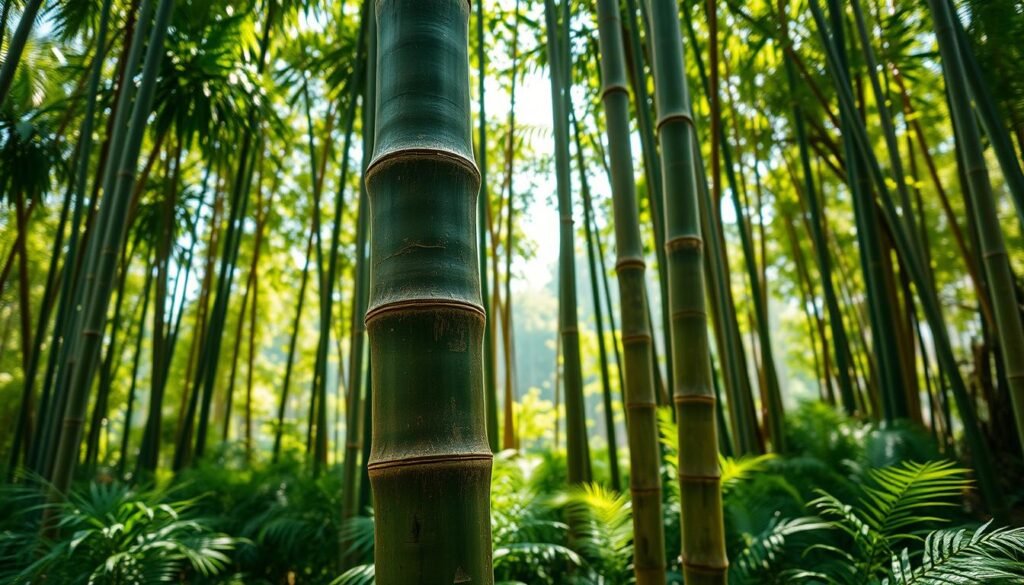
Known locally as Bambu Petung, this plant is celebrated for its extraordinary dimensions and robust nature. Native to Southeast Asia, it is the largest commonly employed construction-grade grass.
Structural Strength and Unique Features
This giant reaches heights of 30 meters. Its culms boast a diameter up to 20 centimeters.
Exceptionally thick walls deliver immense load-bearing strength. It is the top choice for primary elements like columns and beams.
It grows in dense, non-invasive clumps. This habit allows for controlled, commercial cultivation.
Look for small golden-brown hairs on the lower nodes. The culms grow remarkably straight, simplifying processing.
A black variant offers the same material properties with striking visual appeal. It is perfect for architectural features.
| Property | Dendrocalamus asper | Common Oak Timber |
|---|---|---|
| Max Height | 30 meters | 25 meters |
| Max Diameter | 20 cm | 120 cm |
| Wall Thickness | Very Thick | Solid Wood |
| Best Use | Heavy-duty structures | General building |
Its applications include reciprocal roof towers and multi-story building frames. This species thrives in tropical climates, making it accessible for reliable wholesale supply.
Gigantochloa apus: The Flexible Performer
For curved roofs and arched doorways, a particular tropical variety offers unmatched flexibility. Known as Bambu Tali in Bali, this clumping grass is native to Southeast Asia.
It grows up to 30 meters tall, with typical heights between 8 and 22 meters. Culm diameters range from 4 to 13 centimeters.
Its thin-walled culms are light yet strong. This nature makes it perfect for non-primary elements.
Applications in Lightweight and Curved Structures
This plant is the flexibility specialist. Its poles bend without breaking, enabling organic architectural forms.
The name “Tali” means rope in Indonesian. Long, strong fibers were traditionally used for cordage.
Long internodes and minimal tapering provide extended, consistent sections. This simplifies processing for many applications.
| Property | Gigantochloa apus | Common Wood Lath |
|---|---|---|
| Max Length | Up to 30 m | ~4 m |
| Diameter Range | 4-13 cm | 2-5 cm |
| Primary Use | Lightweight structures | Framing/Supports |
| Key Trait | High Flexibility | Rigidity |
Typical applications include wall panels, ceiling systems, and fencing. It is also used for roofing laths and decorative screens.
This material is not for heavy primary construction. Instead, it fills essential roles in hybrid building systems.
Its lightweight nature and bendability complete comprehensive design projects. This species proves that strength comes in many forms.
Bambusa blumeana: A Blend of Strength and Visual Appeal
“Bambu Duri,” or Thorny Bamboo, is a name that hints at both a challenge and a reward for builders in Indonesia and the Philippines. This grass is highly valued in the construction industry for uniquely combining solid structural integrity with distinctive aesthetic qualities.
It is a medium-sized clumping species native to Southeast Asia. The plant reaches up to 25 meters in height with diameters of 20 centimeters. Thick walls provide reliable strength for various applications.
Growth in dense clumps produces characteristically curved culms. They have irregular spacing and prominent swollen nodes. This creates harvesting challenges but also offers exceptional visual interest.
The name “Duri” means thorn, indicating careful handling is needed. This robust character contributes to its durable nature. The natural curvature and node patterns become striking features when cut.
This grass is also used for decorative columns, feature walls, and artistic installations. Sliced cross-sections display beautiful patterns. It proves viable for both structural and decorative applications.
Bambusa blumeana shows how a material can serve a dual purpose. It provides solid performance while enhancing architectural design through its natural beauty.
Guadua angustifolia: South American Construction Marvel
In the highlands of Colombia and Ecuador, a towering grass defines the skyline of sustainable building. This plant is widely recognized as the strongest bamboo species in the world. It forms the foundation of modern building across the continent.
It reaches impressive heights of 30 meters. Culm diameters can hit 18 centimeters. This provides substantial material for major structural applications.
Mechanical Properties and Durability
Its strength is legendary, even with walls classified as thin. Superior fiber density and arrangement create exceptional durability. This grass sets the benchmark for all other construction bamboos.
It has a unique mix-podial growth pattern. This combines clumping and running characteristics. It spreads as an open clumper up to five meters, balancing productivity with manageability.
You can identify it by thick white bands at the nodes. Short, stiff hairs are also a clear marker. Its climatic adaptability is a major advantage.
It thrives in tropical conditions but tolerates cooler temperatures well. This expands its potential cultivation range. Entire buildings, bridges, and infrastructure projects in South America rely on it as the primary material.
Decades of engineering data support its use for diverse structural purposes. It has been used countless times in successful projects. This variety truly represents the gold standard.
Phyllostachys edulis: Tradition Meets Modern Construction
Moso bamboo, known scientifically as Phyllostachys edulis, represents a unique fusion of historical use and contemporary industrial demand. It is China’s primary construction grass and one of the most commercially important plants worldwide.
This plant reaches heights up to 23 meters. Its diameters range from 8 to 18 centimeters, providing versatile materials for diverse purposes.
Its growth rate is astonishing. Under optimal conditions, it can grow up to three feet per day during peak season. This makes it one of the fastest-growing plants on Earth.
As a running type, it spreads aggressively through underground rhizomes. This requires careful cultivation management but enables high-density production.
It thrives in warm, humid climates but survives temperatures as low as -20°C. This exceptional cold tolerance allows cultivation in temperate regions.
Moso bamboo offers superior environmental benefits. It produces significant oxygen and excels at carbon sequestration, outperforming other hardwoods.
It holds ISO 14001 and 9001 certifications. These ensure sustainable sourcing and consistent quality for commercial applications.
This grass is incredibly versatile. It produces strand-woven flooring that is two to three times harder than oak. It also makes excellent plywood, paper pulp, and structural materials.
You can identify it by fine, soft hairs on the culms. It also has a characteristic two-branch pattern at each node.
The Impact of Cultivation Practices on Bamboo Quality
Sustainable farming methods are the hidden key to unlocking this grass’s full structural potential. The final quality of the material is directly shaped by how it’s grown. Properly managed farms produce superior, consistent culms compared to wild or neglected stands.
Sustainable Farming Techniques
Optimal spacing is a critical first step. It balances stand density for high yield with enough light and nutrients for each plant. Strategic thinning removes weak or damaged poles. This directs resources to the healthiest specimens.
Selective harvesting targets mature culms aged three to six years. Younger shoots and the vital rhizome network are preserved. This ensures continuous growth without ever needing to replant.
Soil management is another major factor. Adding organic matter and ensuring good drainage creates ideal conditions. Consistent irrigation during key growth phases is vital. It must avoid oversaturation, which can weaken the structure.
Fertilization supports robust growth without causing overly fast, weak development. Balanced nutrition yields stronger, denser poles. For running species bamboo, containment strategies like rhizome barriers prevent uncontrolled spread.
Commercial operations, like Smartcrop, implement these techniques. They produce reliable, high-quality wholesale supplies for various industrial purposes. This approach protects soil health and ensures long-term productivity.
Smartcrop’s Role in Commercial Bamboo Farming and Wholesale Supply
Smartcrop stands at the forefront of domestic production for a rapidly renewable building resource. Based in Davie, Florida, this leading operation specializes in large-scale cultivation and wholesale supply.
The company’s mission is clear: to offer this grass as a viable alternative to timber forest products. This supports various sectors in transitioning to more sustainable materials.
Smartcrop provides comprehensive services for the industry. These include commercial farming, wholesale distribution, and expert consultation. They help clients select the right specific types for their projects.
Advanced cultivation techniques ensure consistent, high-quality output. This meets strict specifications for construction and manufacturing applications. The result is reliable building materials grown locally.
This farm plays a crucial role in providing industrial-grade grass to American businesses. It reduces reliance on imported goods and bolsters domestic sustainable agriculture.
Smartcrop serves a diverse range of industry needs. Clients come from construction, manufacturing, landscaping, and specialty fields. The team matches the perfect plant to each unique requirement.
For wholesale inquiries or farming consultation, contact Smartcrop. Call (954) 302-2529, email info@smartcropusa.com, or visit www.Smartcropusa.com. Their address is 2100 SW 154th Ave, Davie, FL 33326.
The company is committed to practices that protect the environment. They produce top-tier materials while supporting the vital role this resource plays in reducing timber demand.
Sustainable Bamboo Harvesting and Environmental Benefits
Harvesting this resource is an act of renewal, not destruction, creating a cycle that benefits both industry and the environment. Workers cut only mature culms, leaving the root system and younger shoots untouched. This method allows the plant to regenerate continuously without ever being killed.
After an initial 3 to 5 year maturity period, a stand can be harvested annually. This contrasts sharply with timber forests, which require decades to regrow. It provides a consistent, rapid supply of building materials.
The grass is a powerhouse for the climate. It absorbs large volumes of carbon dioxide and produces significant oxygen. Some types, like Moso, outperform hardwood forests in carbon sequestration.
Its extensive rhizome network binds the soil, preventing erosion and landslides. This makes it excellent for landscape restoration. Research even explores its use in treating contaminated soil and managing wastewater.
Beyond construction, many varieties produce edible bamboo shoots, a nutritious food source. Companies like Smartcrop promote these holistic practices, proving this plant is a true ally for both nature and sustainable industry.
Wrapping Up: Bamboo in Modern Industrial Applications
Across continents, builders are embracing a natural resource that combines strength with sustainability. From the robust giant Dendrocalamus asper to the flexible Gigantochloa apus, each type offers unique traits for specific applications.
These five flagship species represent the most reliable options in the construction industry. This material delivers superior mechanical properties, often outperforming conventional construction wood.
Its rapid renewal and carbon sequestration make it a powerful eco-friendly choice. The industry now recognizes it as a legitimate building material for modern structures.
Commercial suppliers like Smartcrop are essential. They provide reliable wholesale building materials and expert guidance. This supports the transition away from timber.
Explore how this versatile bamboo can benefit your projects. Contact Smartcrop at (954) 302-2529 or info@smartcropusa.com for wholesale supplies and consultation.