What if the most powerful tool for fighting climate change is already growing wild across millions of acres? This ancient grass is stepping into a modern role. It is transforming how we think about environmental responsibility and economic growth.
The global push for sustainable practices is reshaping industries. Agriculture and forestry are at the forefront of this change. Innovative approaches are turning waste into wealth and opening new revenue streams.
Countries like Vietnam are leading the way. According to the Ministry of Agriculture, the country currently has nearly 1.6 million hectares of this versatile plant across various provinces. Regions like Thanh Hoa are major production hubs. They supply tens of millions of culms to the market each year.
Pioneering companies are unlocking even more value. For example, Bamboo King Vina in Thanh Hoa province is converting leftover biomass into biochar. This process tackles forestry waste and creates a pathway to the carbon market.
This trend presents a significant opportunity for American businesses. Firms like Smartcrop are bringing these solutions to the United States. They offer commercial farming, wholesale plants, and timber replacement services. You can contact them at (954) 302-2529 or info@smartcropusa.com.
This article will explore how these mechanisms work. We will examine the innovative techniques involved and the real-world impacts. Finally, we will look at the future of this sustainable sector.
Key Takeaways
- The global demand for sustainable agriculture and forestry solutions is creating new opportunities.
- Bamboo is a rapidly renewable resource with significant potential for carbon sequestration.
- Countries like Vietnam have established large-scale plantations, demonstrating commercial viability.
- Innovative processing, like converting waste to biochar, unlocks additional value and market access.
- U.S. companies like Smartcrop are positioned to bring these practices to the American market.
- Exploring bamboo-based solutions can offer both environmental and economic advantages.
- Understanding carbon credit mechanisms is essential for leveraging these opportunities.
Deep Dive into Bamboo Carbon Credit ESG Benefits
A project in Vietnam shows how agricultural waste can be transformed into a high-value environmental commodity. Bamboo King Vina has successfully navigated the complex carbon credit registration process. Their initiative is registered under the Verified Carbon Standard (VCS) by Verra.
Understanding Carbon Credit Mechanisms in Bamboo Farming
The credit registration processes under standards like VCS are rigorous. They validate emission reductions and convert them into tradable units called VCUs. Bamboo King Vina’s project, with ID 5108, has a crediting period from 2024 to 2031.
It is estimated to reduce about 112,000 tons of CO₂ equivalent each year. Over seven years, this totals nearly 784,000 tons. These verified carbon removal credits can trade for $100 to $300 each.
The Role of ESG in Modern Agricultural Practices
This work aligns perfectly with corporate Environmental, Social, and Governance goals. A key environmental win comes from producing biochar. This material cuts nitrous oxide (N₂O) emissions from soil.
N₂O is a potent greenhouse gas with a global warming potential hundreds of times greater than CO₂. Social and governance aspects include transparent reporting and community engagement.
For U.S. businesses, firms like Smartcrop offer expertise. They guide operations through commercial farming and carbon credit registration. Contact them at (954) 302-2529 or info@smartcropusa.com for a consultation.
Innovative Bamboo Farming and Biochar Production Techniques
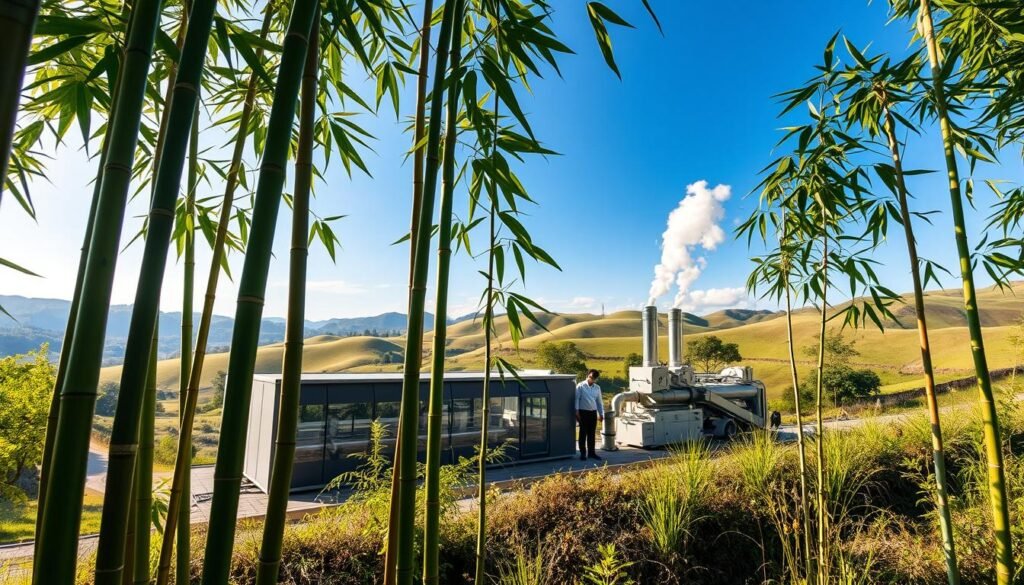
A Vietnamese company has built a circular economy model from what was once considered trash. Advanced techniques now transform massive amounts of agricultural residue into a stable, useful product.
Case Study: Bamboo King Vina’s Biochar Transformation
Each day, Bamboo King Vina processes about 1,500 tons of material. This creates 800-900 tons of leftover branches, scraps, and sawdust.
Before mid-2024, this waste was burned or left to rot. It released harmful gases and particles into the air. The company’s new project changes everything.
They invested in six high-tech pyrolysis lines. This equipment heats biomass without oxygen at 600-800°C. The process locks carbon into solid biochar and captures gases to fuel itself.
The annual design capacity is impressive at 47,520 tons. Mr. Do Quoc Thai, Chairman, leads this vision. He plans to expand to 15 factories nationwide.
The company will focus on supplying biochar production equipment and expert consultancy. This biochar, made from plant waste, has multiple uses.
| Application Method | Key Advantages | Scale Potential |
|---|---|---|
| Direct Soil Application | Improves structure instantly, boosts water retention | Large-scale field use |
| Indirect Use via Livestock/Composting | Enriches feed and compost, reduces odors | Integrated farm systems |
| Industrial Sludge Treatment | Stabilizes waste, captures contaminants | Municipal and industrial |
Sustainable Waste Conversion and Emission Reductions
This system stops dangerous outdoor burning. It significantly cuts methane and nitrous oxide releases.
The carbon-rich material helps improve soil health for centuries. It acts like a sponge, holding water and nutrients.
Farmers can use less chemical fertilizer. Their land becomes a natural, long-term storage site for carbon.
For American operations, similar systems offer great promise. Firms like Smartcrop provide consultation on implementing this technology.
They offer commercial farming solutions and wholesale plants. Contact them to explore these techniques: (954) 302-2529 or info@smartcropusa.com.
Economic and Environmental Impacts of Bamboo-Based Solutions

Agricultural innovation now offers a way to cut costs and boost harvests while actively cleaning the atmosphere. This creates a powerful win-win for modern farms.
The system delivers clear economic benefits for farmers. It turns waste into a valuable soil amendment.
Boosting Crop Yields and Reducing Fertilizer Dependency
Returning biochar to the fields is a game-changer. It significantly improves soil fertility and water retention.
This practice directly boosts plant growth. It leads to thereby increasing crop production reliably.
Farmers see crop yields reducing their reliance on expensive inputs. The material reduces the need for chemical amendments substantially.
This means lower bills for need chemical fertilizers. It translates to reducing production costs year after year.
Carbon Credit Registration and Environmental Compliance
Participating in a verified carbon credit registration program unlocks new revenue. It turns environmental stewardship into a tangible asset.
This process helps operations meet strict sustainability targets. For a deeper look at these mechanisms, explore this resource on bamboo carbon farming.
Enhancing Soil Health and Structure for Long-Term Sustainability
The long-term effect on land is profound. Biochar creates a stable, porous structure in the earth.
It enhances microbial life and prevents nutrient leaching. This improves nitrogen soil use efficiency dramatically.
A major environmental win is cutting nitrous oxide (N₂O). This is a potent greenhouse gas mainly released from farm soil.
The gas is mainly produced during the produced transformation of nitrogen from fertilizers. Its global warming potential is hundreds of times greater than CO₂.
| Impact Area | Economic Benefit | Environmental Benefit |
|---|---|---|
| Soil Health | Higher yields, lower input costs | Improved structure, carbon storage |
| Fertilizer Use | Reduced purchase needs | Less runoff, lower N₂O emissions |
| Carbon Revenue | New income from credits | Verified emission reductions |
For U.S. farmers, Smartcrop’s Commercial Bamboo Farming services provide a direct path to these gains. They help integrate these practices efficiently.
Contact them to start: (954) 302-2529 or info@smartcropusa.com.
Looking Forward: Advancing Bamboo Innovations for a Greener Tomorrow
Looking ahead, regenerative farming methods are creating new pathways for both ecological restoration and financial growth. The convergence of technology, policy, and market demand positions these sustainable practices at the forefront of American agriculture.
Emerging research continues to enhance the efficiency and impact of bamboo-based systems. Supportive regulatory frameworks and growing investment are accelerating adoption across the United States.
Smartcrop is leading this transformation domestically. The company provides the infrastructure and expertise to scale these bamboo innovations successfully.
Their services include Commercial Bamboo Farming, Wholesale Bamboo & Tropical Plants, and Bamboo as a Replacement for Timber Forests. They enable businesses to participate directly in this sustainable revolution.
For those ready to explore these opportunities, contact the team today. Reach them at (954) 302-2529 or info@smartcropusa.com. Their address is 2100 SW 154th Ave, Davie, FL 33326.