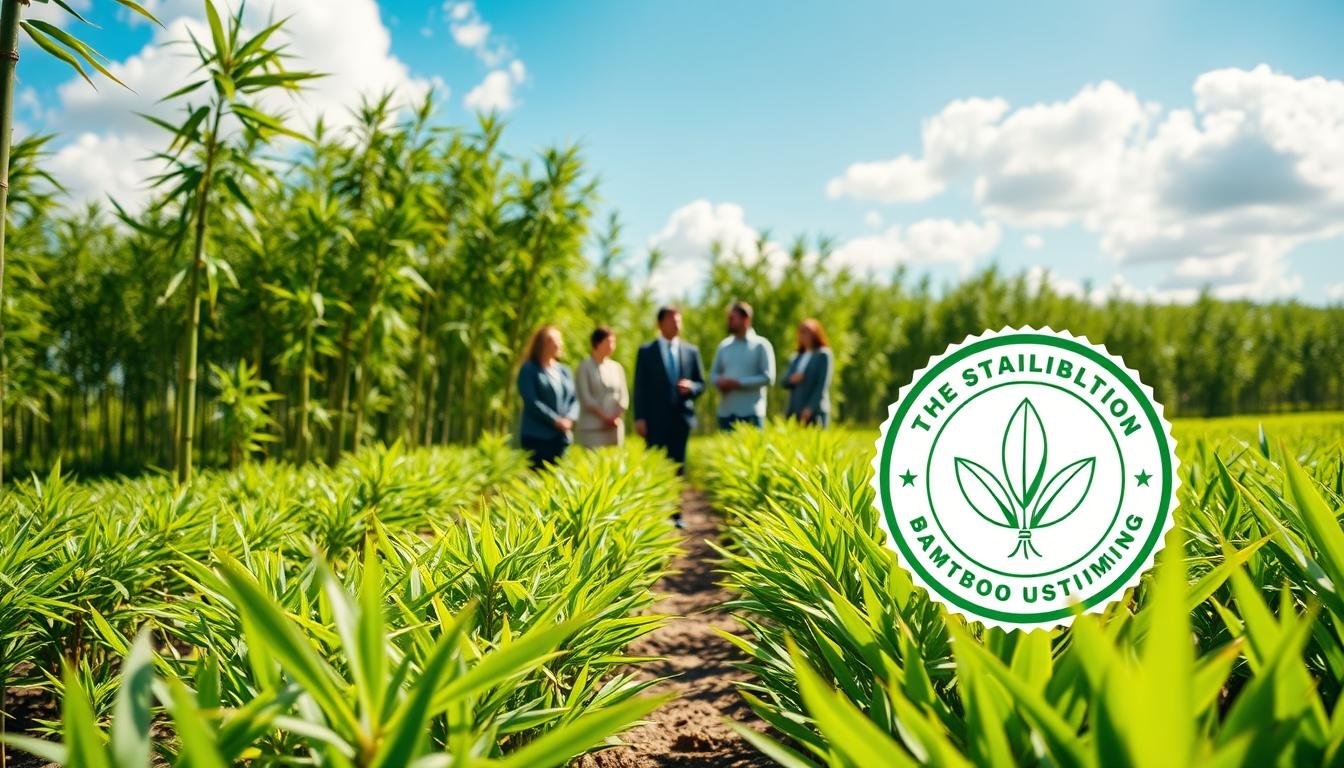
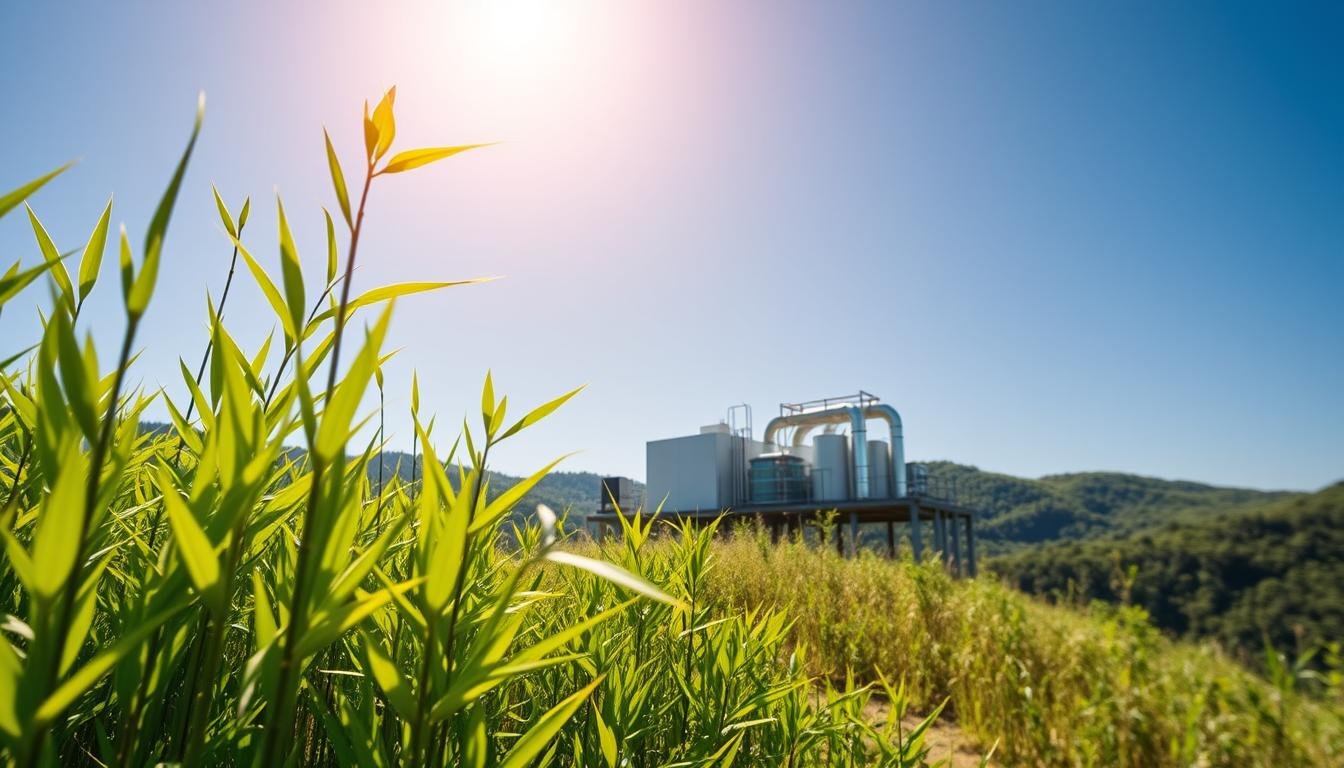
What if a single plant could power your home for a month and help fight climate change at the same time?
This isn’t science fiction. It’s the reality of a remarkable, fast-growing crop that is changing the game for sustainable power. According to the International Bamboo and Rattan Organisation (INBAR), just one mature pole from this plant provides enough energy for a rural household’s entire month.
Nations like India, China, and Brazil are already using this resource extensively. They leverage its high energy yields and credibility as a viable renewable energy source. This shift addresses global sustainability challenges and reduces our heavy reliance on fossil fuels.
Our analysis explores how this innovation is revolutionizing power solutions. We’ll look at technical details, commercial applications, and environmental benefits. The discussion also covers market trends and the entire value chain, from farmers to policy makers.
This lignocellulosic material represents a critical solution for the 21st century. It offers reliable power for both remote communities and large-scale industry. Understanding its potential is key to a cleaner, more secure energy future.
Key Takeaways
- A single bamboo pole can generate enough power for a household for a full month, showcasing its high energy density.
- This fast-growing, non-food crop is a leading renewable material for producing sustainable fuel.
- Countries across Asia and South America are pioneers in adopting this energy system at scale.
- The analysis covers the technical, commercial, and environmental aspects of this growing sector.
- Key players include commercial growers, energy producers, and government policymakers.
- This resource is vital for climate change mitigation and building resilient energy systems.
- It provides a dependable power source for both rural electrification and industrial applications.
Introduction to Bamboo Biomass & Biofuel Supply
Faced with a projected near-doubling of global energy demand by 2040, the planet needs a versatile, renewable feedstock.
Consumption is set to jump from 540 quadrillion Btu in 2012 to 815 quadrillion Btu. This surge creates a critical need for sustainable power sources.
Bamboo, a fast-growing, non-food plant material, offers a solution. It belongs to the lignocellulosic family. This means it doesn’t compete with food crops.
The biomass can be processed into various forms of fuel. These include solid pellets, liquid ethanol, and gaseous fuels. Its high energy content and quick harvest cycle make it ideal.
International climate goals are driving adoption. This resource helps reduce carbon emissions and fossil fuel reliance. It complements other renewables like solar and wind.
Farmers, processors, and power plants all play a role in its supply chain. Together, they are building a cleaner energy future.
Smartcrop Overview and Market Presence
In the heart of Florida’s agricultural landscape, a company is pioneering a new path for domestic renewable resources. Smartcrop, based in Davie, Florida, operates as a leading provider of commercial farming and wholesale solutions. The firm addresses the burgeoning demand for sustainable materials across the United States.
Company Background and Contact Details
Smartcrop’s headquarters are at 2100 SW 154th Ave, Davie, FL 33326. Businesses can contact them at (954) 302-2529 or via email at info@smartcropusa.com. Their website, www.Smartcropusa.com, provides comprehensive service details.
These services include commercial farming of high-yield bamboo species, wholesale distribution of bamboo and tropical plants, and offering a sustainable alternative to timber forests. They focus on plants selected for optimal biomass output. This methodology supports both renewable energy and construction sectors.
Commitment to Sustainable Energy Practices
The company demonstrates a strong commitment to eco-friendly operations. They employ responsible cultivation methodologies and manage their supply chain with sustainability as a core principle. This approach facilitates renewable energy development and reduces dependence on imported materials.
Smartcrop’s expertise contributes to domestic infrastructure for a cleaner future. Their work provides a reliable source for both energy and timber replacement applications. They cultivate adaptable species suited to various U.S. climates.
Understanding Bamboo as a Renewable Energy Source
Scientific research is confirming what traditional use has long suggested: bamboo possesses outstanding qualities for fuel. It ranks among the most productive and fastest-growing plants on Earth.
This plant offers desirable fuel characteristics. It has high heat values and volatile contents. It also features lower ash and reduced moisture compared to traditional woody biomass.
The resource is incredibly versatile as an energy source. It can be converted into solid fuels like pellets, liquid fuels like bioethanol, and gaseous fuels like biogas.
Its short rotation cycle and rapid growth enable sustainable harvesting. This makes it a truly renewable feedstock. Studies on various species confirm this potential for reliable, scalable energy needs.
Innovative Approaches in Bamboo Biomass Biofuel Supply
Global research partnerships are unlocking new methods to turn fast-growing plants into powerful fuel.
Institutions like RMIT University and the Center for International Forestry Research have teamed up with Clean Power Indonesia. Their joint study examines how bamboo works as a fuel and why it may be greener than traditional wood.
The conversion of this biomass involves two main technological paths. Thermal methods, including gasification, create solid products like charcoal and pellets. Biochemical techniques, such as fermentation, can produce advanced liquid biofuels.
These advanced processes yield energy-dense outputs. Briquettes and pellets can directly substitute for wood-based fuels in industrial and residential heating.
Companies like Smartcrop implement innovative cultivation and harvesting techniques. They optimize crop yields specifically for high-yield energy production. This ensures a consistent feedstock supply for processing facilities.
Integrated system models combine commercial farming with biofuel production plants. This vertical approach streamlines the entire chain. It maximizes energy extraction while minimizing waste and environmental impact throughout the conversion process.
Bamboo Growth and Environmental Advantages
Beyond its iconic stalks, this remarkable grass holds a Guinness World Record for speed and a vital role in carbon capture. Its growth profile and ecological benefits make it a standout resource for sustainable projects.
Rapid Growth and Regeneration Capabilities
This plant is the fastest-growing on Earth. Certain species can grow up to 3.8 centimeters per hour.
It reaches maturity in just 5 to 6 years. After that, the stand can be harvested and thinned every year. The plant regenerates from its existing root system.
- Eliminates the need for replanting.
- Ensures a continuous supply.
- Reduces labor and input costs significantly.
Carbon Sequestration and Ecological Impact
One hectare of this crop can absorb up to 17 tons of carbon dioxide annually. This powerful carbon sequestration directly helps mitigate climate change.
It thrives on degraded land with minimal water and fertilizer. Its dense root network stabilizes soil and prevents erosion effectively.
This combination of speed, resilience, and ecological benefit is unmatched. It offers a practical path for land restoration and sustainable resource use.
Commercial Bamboo Farming Practices
Establishing a productive plantation requires careful planning and specialized knowledge. Companies like Smartcrop apply scientific methods to maximize yield for biomass production.
Selecting the right species is critical. Growers choose varieties with high growth rates and adaptability to local climates. This ensures a consistent feedstock supply.
This tropical plant thrives on degraded land. It needs minimal water and fertilizer. Its root system stabilizes soil and improves water retention.
Plant development is rapid. A stand matures in 5 to 12 years. After that, systematic yearly thinning actually boosts long-term productivity.
These sustainable practices make commercial farming economically viable. They provide a reliable source for energy utilization and support land rehabilitation efforts.
Wholesale Bamboo & Tropical Plants Market Trends
Across Asia, a quiet revolution is taking place as power plants begin integrating a fast-growing grass into their fuel mix. Nations like China, India, and Indonesia are leading this change. They use this resource as a primary feedstock to reduce fossil fuel reliance.
This shift creates powerful market dynamics globally. Demand is rising for both ornamental products and industrial-grade material.
Global Bamboo Market Dynamics
Policy drivers are accelerating adoption. Renewable energy targets and carbon reduction goals make this feedstock attractive. Japan, South Korea, and Thailand are also expanding its use.
The wholesale sector connects farms with energy producers. It ensures a consistent flow of quality resources.
Trends in the United States
Interest in domestic cultivation is growing rapidly. Companies like Smartcrop are pivotal. They provide reliable wholesale services and support development of local supply chains.
This reduces import dependence and builds infrastructure for a sustainable energy future.
| Market Aspect | Global Trend | U.S. Trend |
|---|---|---|
| Primary Driver | National renewable energy policies | Desire for energy independence |
| Key Application | Power plant co-firing | Industrial biomass & ornamental products |
| Supply Chain Focus | Large-scale cultivation & export | Domestic cultivation & distribution |
| Competitive Edge | Established processing infrastructure | Quality assurance & adaptive species |
Sustainable Techniques in Bamboo Cultivation
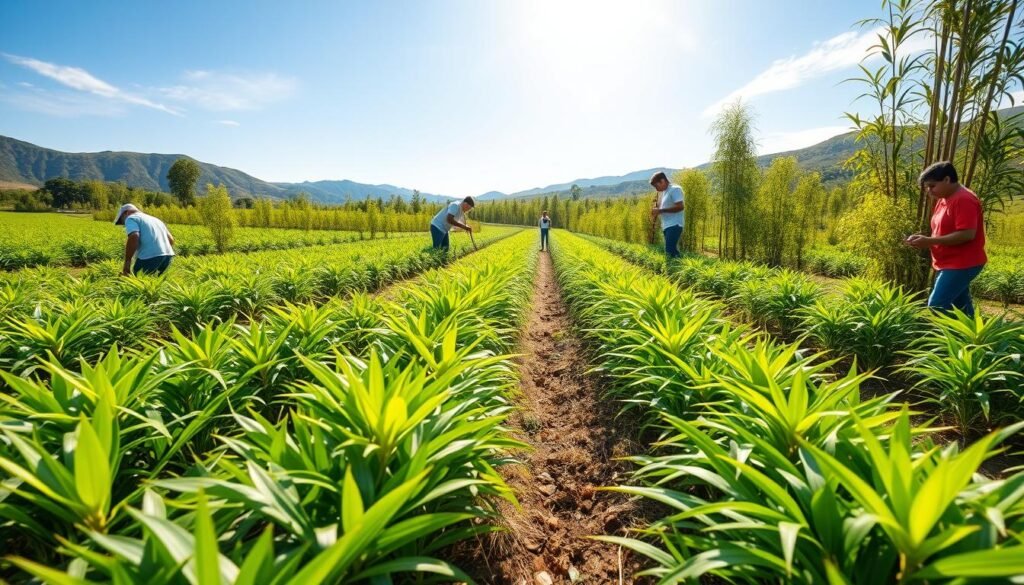
Modern agriculture embraces techniques that work with nature, not against it. Sustainable cultivation maximizes production efficiency while minimizing environmental impact and resource consumption.
Water management is crucial. Selected species thrive with minimal water inputs compared to traditional crops. This reduces consumption significantly.
Harvesting involves selective thinning rather than complete removal. This approach allows natural regeneration and maintains continuous production cycles. Yearly thinning actually boosts long-term productivity.
Cultivation on degraded lands provides dual benefits. It yields material while rehabilitating soil through stabilization and erosion control. The plant’s root system improves water retention naturally.
Integrated agroforestry systems create diverse ecosystems. They support biodiversity while generating multiple revenue streams. This approach represents smart land utilization.
Waste minimization strategies ensure full plant component utilization. Cultivation byproducts convert into valuable materials, enhancing overall efficiency. Sustainable fertilization practices leverage the plant’s minimal nutrient requirements.
Conversion Technologies for Bamboo Energy
Turning a fast-growing crop into electricity and heat requires a suite of specialized engineering techniques. These methods transform raw plant material into usable power efficiently.
Thermal Conversion Processes
Thermochemical pathways use heat to break down the feedstock. Gasification creates a clean synthetic gas and charcoal as a valuable by-product in one cost-effective step.
Pyrolysis operates in an oxygen-limited environment. It yields liquid bio-oil, syngas, and solid biochar. Another direct method is firing the material to produce steam for turbines.
Co-firing blends the renewable resource with coal. This reduces carbon emissions while maintaining reliable output from existing power plants.
Biochemical Conversion and Fermentation
This pathway uses biological agents like enzymes and microbes. It breaks down the plant’s cellulosic structure to produce liquid biofuels.
A crucial pretreatment step prepares the material for this process. Enzymatic hydrolysis and fermentation then convert the sugars into ethanol or other advanced fuels.
| Conversion Process | Primary Method | Key Outputs | Typical Scale |
|---|---|---|---|
| Gasification | Thermochemical | Syngas, Charcoal | Medium to Large |
| Pyrolysis | Thermochemical | Bio-oil, Syngas, Biochar | Pilot to Medium |
| Direct Combustion | Thermochemical | Heat, Steam, Electricity | Small to Large |
| Co-firing | Thermochemical | Electricity (Lower Carbon) | Large (Power Plants) |
| Biochemical | Enzymatic/Fermentation | Bioethanol, Biogas | Pilot to Commercial |
Biofuel Production: From Bamboo to Energy
Inside a biorefinery, powerful chemical and biological processes unlock the energy stored within plant fibers. This biochemical conversion pathway is key for creating liquid and gaseous fuel.
The plant’s tough structure must first be broken down. This essential pretreatment step opens up the cellulose for further processing. Common methods include dilute acid, alkaline, organosolv, and steam explosion.
A high lignin content (29-46%) makes this material excellent for solid fuel. It also provides higher heating values. For liquids, sugars released during pretreatment undergo fermentation into bioethanol.
| Pretreatment Method | Key Agent | Glucose Yield (g/g) | Primary Advantage |
|---|---|---|---|
| Dilute Acid | Sulfuric Acid | 0.15 – 0.30 | Cost-effective, well-studied |
| Alkaline | Sodium Hydroxide | 0.25 – 0.40 | Effective lignin removal |
| Steam Explosion | High-Pressure Steam | 0.30 – 0.456 | High yield, no chemicals |
| Organosolv | Organic Solvents | 0.35 – 0.42 | Pure lignin recovery |
An integrated approach uses all plant components. This maximizes production efficiency. Research shows this crop is a strong substitute for wood in advanced fuel applications.
Research and Trend Analysis in Bamboo Biofuels
A surge in published studies is quantifying the exact properties that make this fast-growing crop a fuel powerhouse. This body of work provides the hard data needed to guide commercial decisions and policy.
Key Studies and Data Insights
Landmark research offers clear insights. A 2017 study in BioResources highlighted the plant’s potential as a suitable fuel from Malaysia’s perspective.
It shares desirable fuel characteristics with other woody materials. Earlier work by Engler et al. provided specific numbers.
It showed the energy content for species like Phyllostachys pubescens is 19.44 MJ/kg. Bambusa emeiensis registered 18.32 MJ/kg.
Another critical study by Littlewood et al. examined bioethanol potential. It found certain Chinese varieties have a sugar content of about 62% of dry matter.
This indicates high yield for liquid fuel production. The trend in academic research is toward optimizing conversion and scaling up.
Analysis of this data across different species helps identify the best candidates for reliable energy output.
Overcoming Challenges in Bamboo Biomass Production

Despite its high potential, the path to large-scale commercial energy from fast-growing crops is fraught with hurdles. Most major projects remain in pilot phases, limiting immediate commercial viability.
Scaling from decentralized systems to national grids presents technical and logistical barriers. Optimization of conversion methods is needed to improve fuel yields and reduce energy consumption.
Sustainability concerns are critical. Vast monoculture plantations risk deforestation and biodiversity loss if not managed carefully. This mirrors ecological issues seen with other wood-based fuels.
Economic factors include high production costs and competition with established fossil fuels. Oil price volatility also affects investment decisions in this sector.
Strategies to overcome these issues include technology innovation, policy support, and integrated biorefinery approaches. The table below outlines key challenges and solutions.
| Challenge Category | Specific Issue | Potential Solution |
|---|---|---|
| Technical | Low conversion process efficiency | Advanced pretreatment & optimized fermentation |
| Economic | High production cost & infrastructure investment | Government subsidies & scale economies |
| Environmental | Risk of monoculture & waste management | Diverse cropping systems & by-product utilization |
| Logistical | Supply chain development for large-scale feed | Localized processing hubs & improved transport |
Addressing these barriers is essential for this renewable resource to reach its full potential. A concerted effort from researchers, industry, and policymakers can turn challenges into opportunities.
Climate Change Mitigation Through Bamboo Bioenergy
The fight against a warming planet has found a powerful ally in a rapidly renewable resource. This approach turns a fast-growing plant into a tool for cutting greenhouse gases.
One hectare of bamboo can absorb up to 17 tons of carbon dioxide yearly. This active sequestration removes harmful gases from the air.
Reducing Carbon Emissions with Renewable Fuel
When burned for energy, the plant releases only biogenic carbon. This is carbon already cycling in nature, not ancient carbon from fossil sources.
Co-firing this biomass with coal in power plants slashes the need for coal. It directly lowers emissions of carbon dioxide, sulfur dioxide, and nitrogen oxides.
This renewable fuel helps nations meet international climate commitments. Countries like Malaysia are signatories to the UN Convention on Climate Change.
Using this renewable energy supports global goals. It provides a reliable path to a cleaner future.
Economic Impact and Policy Support for Bamboo Energy
Pilot projects in remote islands are proving that sustainable energy can transform communities. In Indonesia’s Mentawai islands, a Clean Power Indonesia initiative brought reliable electricity to 1,250 households across three villages. Each village now has its own power plant using bamboo feedstock.
This approach tackles energy poverty for over 50 million people in rural Indonesia. It also creates jobs in cultivation, processing, and energy production. Similar projects in Ghana, Ethiopia, and Colombia show global viability for this use.
Government policies are crucial for sector development. Support includes renewable energy subsidies, carbon credits, and tax incentives. Research funding programs also drive innovation in this sector.
| Policy Mechanism | Primary Benefit | Example Implementation |
|---|---|---|
| Renewable Energy Subsidies | Lowers production costs for developers | Feed-in tariffs in several Asian nations |
| Carbon Credit Programs | Provides additional revenue streams | Compliance markets in Europe and North America |
| Tax Incentives & Grants | Encourages private investment in infrastructure | U.S. Department of Agriculture grants for bioenergy |
| Research Funding | Advances conversion technology efficiency | Public-private partnerships in Indonesia and Colombia |
Companies like Smartcrop contribute by operating commercial farms. They provide a reliable supply of resources and create local employment. Their work supports the entire system, from farming to energy production.
This renewable resource reduces dependence on imported oil. It keeps energy spending within local economies. Investment trends show growing private sector and development finance interest.
Future Directions in Bamboo Biomass and Biofuel Supply
Emerging technologies are set to redefine how we harness energy from fast-growing grasses. Experts predict its potential will be recognized on a much larger scale within five to ten years.
This shift is fueled by a worldwide push for sustainable solutions. Countries like the US and several in Europe are investing in co-firing tech.
Innovations Driving the Next Generation of Biofuel
Advanced conversion methods are key. They focus on producing hydrogen from this resource through gasification.
Integrated biorefineries will extract multiple products simultaneously. This maximizes value from the feedstock.
Research and Development Initiatives
Global research aims to improve crop characteristics and optimize processes. Development priorities include genetic enhancement for higher yields.
Specialized varieties for specific fuel applications are also a focus. These efforts are detailed in resources like bamboo for biomass energy production.
| Research Area | Primary Objective | Expected Impact |
|---|---|---|
| Genetic Improvement | Enhance biomass yield per hectare | Higher, more reliable feedstock output |
| Process Optimization | Reduce energy input for conversion | Lower production costs for biofuels |
| Hydrogen Production | Generate clean fuel for cell applications | New markets in transportation and aviation |
| Supply Chain Logistics | Ensure efficient feedstock delivery | Scalable deployment for large facilities |
Companies like Smartcrop are poised to expand operations. They will meet growing demand from these new energy markets.
Reflecting on the Future of Bamboo Energy Solutions
As the world seeks practical solutions for clean energy, one resource is stepping out of the shadows. Global awareness is shifting, recognizing its potential as a powerful, renewable resource for energy generation.
This represents a viable pathway toward energy independence and reduced fossil fuel reliance. Successful projects from Indonesia to Colombia prove its practical viability.
Scaling this solution requires robust commercial farming and reliable supply chains. Companies like Smartcrop are committed to this transition through sustainable cultivation and wholesale services.
Their work supports the entire value chain for biofuel production. Collaboration across sectors will unlock this resource’s full potential.
For partnership in sustainable energy initiatives, contact Smartcrop at (954) 302-2529, info@smartcropusa.com, or visit www.Smartcropusa.com.